
A distributed team can have talented people, reliable technology, and clear business goals while still struggling to move work forward. The problem often appears when progress depends on everyone being available at the same moment. A product manager in New York may finish a requirement update, but an engineer in Europe cannot continue because the reasoning behind a decision was never documented. A designer in Asia may complete a review, but the next person in the workflow has no clear record of what changed or why.
Asynchronous collaboration systems address this challenge by designing work around shared context rather than constant availability. Instead of expecting employees across time zones to participate in every conversation, these systems create reliable ways to exchange information, make decisions, and transfer responsibility. Research on distributed collaboration has highlighted the importance of communication practices and shared understanding when team members cannot interact at the same time.
The goal of asynchronous work is not to remove human interaction or eliminate meetings. It is to create an operating structure where meetings become more valuable, information remains accessible, and progress does not stop simply because someone is offline.
Many organizations approach remote collaboration by adding more communication tools. They introduce chat platforms, video meetings, project management systems, and shared documents, expecting technology to solve coordination problems. However, the biggest challenges in distributed teams are usually not caused by a lack of tools. They come from unclear processes around how information moves through the organization.
In a traditional office, employees often rely on informal communication. Someone can walk over to a colleague’s desk, ask a quick question, or hear important context during an unscheduled conversation. Distributed teams lose many of these natural information flows. Without a replacement system, important knowledge becomes scattered across messages, meetings, and individual memory.
An effective asynchronous collaboration system creates predictable ways for information to move. Team members should know where project decisions are recorded, where updates are posted, who owns specific tasks, and how questions should be handled when immediate discussion is impossible. The system becomes a shared operating environment for coordination rather than simply a collection of digital tools.
This distinction matters because successful asynchronous collaboration depends more on working agreements than software selection. A company can use the same applications as a highly effective remote organization and still struggle if employees do not share expectations about documentation, response times, availability, and decision ownership.
A useful way to design asynchronous collaboration is to think of it as an operating system with several connected layers. Each layer solves a different coordination problem. Together, these layers create a structure that allows distributed teams to work independently while maintaining alignment.
The first layer is the information layer. This is where teams store the knowledge required to understand projects and make decisions. It includes project goals, requirements, processes, meeting summaries, and decision records. The purpose is not to document every conversation but to preserve information that someone else may need to continue the work.
The second layer is the communication layer. Teams need clear rules about which communication method fits different situations. A quick clarification may belong in chat, while a major product decision may require a written proposal that allows people in different locations to review information during their own working hours. Good asynchronous systems reduce unnecessary interruptions by matching communication methods to the purpose of the conversation.
The third layer is the workflow layer. This defines how work moves between people. Tasks need clear ownership, deadlines, and handoff expectations. A person starting work should understand what has already been completed, what decisions have been made, and what information the next contributor needs.
The fourth layer is the decision layer. Distributed teams need visible decision-making processes because people cannot always participate in live discussions. Decision owners, deadlines, options considered, and final reasoning should be easy to locate. This prevents teams from repeatedly reopening the same questions and helps new employees understand previous choices.
Documentation is often treated as an administrative responsibility, but in distributed teams it serves a much more important function. Written information becomes the shared memory of the organization. Without it, employees in different locations are forced to reconstruct context through repeated meetings, private messages, and individual explanations.
Strong documentation focuses on usefulness rather than volume. A document should help someone understand a situation and take action. A project update that says “the timeline changed” provides limited value. A stronger update explains what changed, why the change occurred, what risks exist, who owns the next step, and when the situation should be reviewed again.
Decision records are especially important for cross-time-zone teams. When a decision is made during a meeting that only some employees can attend, the absence of documentation creates unequal access to information. People who were not present may understand the outcome but not the reasoning behind it.
For example, a global product team may decide to delay a feature release because customer feedback revealed usability concerns. A simple status update might record the delay. A stronger decision record would explain the customer insights, alternatives considered, expected impact, responsible owner, and next review date. That context allows future team members to understand the decision without repeating previous discussions.
Cross-time-zone collaboration works best when teams design workflows that allow work to move naturally between regions. The objective is not to create a “follow the sun” model in every situation, but to reduce unnecessary waiting between handoffs.
Consider a global software team with product managers in the United States, developers in Europe, and quality engineers in Asia. If each group depends on live meetings to continue work, progress slows whenever schedules do not overlap. If the workflow includes clear requirements, documented decisions, and visible task ownership, each group can contribute when they are available.
A strong asynchronous workflow answers several practical questions: What information does the next person need? Who is responsible for the next action? What decisions have already been made? What issues require escalation? These questions help teams move work forward without relying on constant availability.
However, many organizations underestimate the importance of handoff quality. A poorly designed handoff creates hidden delays because the next person must spend time searching for context or requesting clarification. Effective teams treat handoffs as a designed process, not an informal transfer of responsibility.
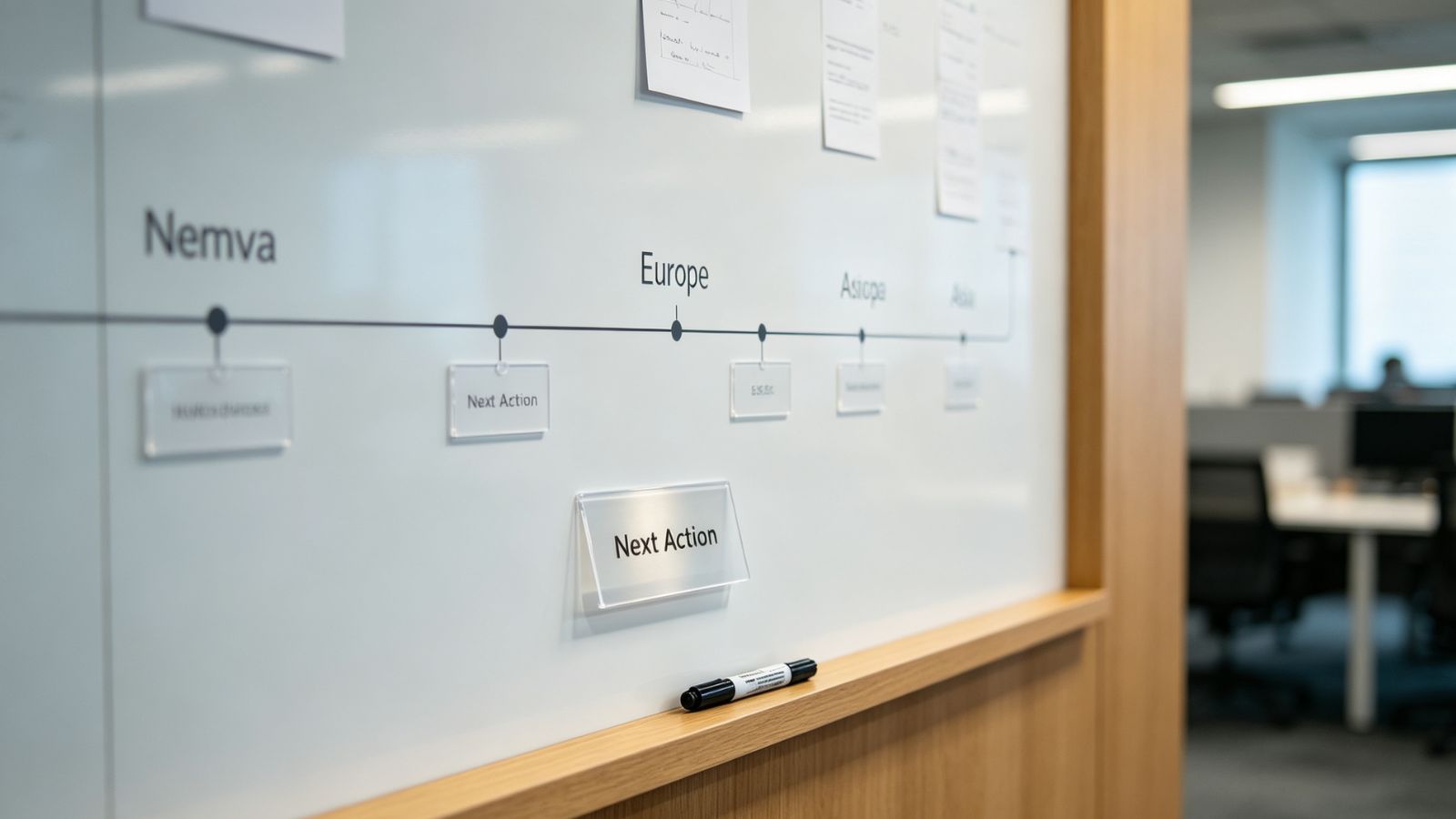
Imagine a software company with employees across North America, Europe, and Asia. Product discussions frequently require meetings because different teams hold different pieces of information. Engineers wait for product clarification, designers wait for approval, and managers spend large amounts of time coordinating schedules.
The company redesigns its collaboration system around asynchronous decisions. Product managers create written proposals before major discussions. Engineers review technical impacts during their own working hours. Designers provide feedback through shared documents. Final decisions include a summary of the reasoning, alternatives considered, ownership, and expected follow-up actions.
After several months, the team does not eliminate meetings completely, but meetings become more focused. Employees arrive with shared context instead of spending most of the time explaining background information. Team members who cannot attend live discussions remain informed because decisions are documented.
The important change is not that communication became less frequent. Communication became easier to continue across locations.
A common misunderstanding is that asynchronous collaboration means eliminating meetings. Effective distributed teams still use meetings, but they become more selective about when real-time discussion creates value.
Meetings are useful for activities that benefit from immediate interaction, such as complex problem-solving, relationship building, conflict resolution, or strategic planning. They are less effective when their primary purpose is simply sharing information that could be reviewed independently.
Before scheduling a meeting, teams should consider whether the goal can be achieved through a written proposal, recorded explanation, project update, or shared decision document. Moving routine updates into asynchronous channels often gives employees more uninterrupted time for focused work.
However, organizations should avoid replacing every interaction with documentation. Teams still need opportunities to build trust and maintain relationships. A healthy asynchronous system reduces unnecessary meetings while preserving meaningful human connection.
The goal is not fewer conversations. The goal is making each conversation more valuable.

One frequent mistake is changing tools without changing behavior. A company may introduce a new project platform but continue relying on private conversations and undocumented decisions. The technology changes, but the collaboration system does not.
Another mistake is confusing documentation with excessive bureaucracy. If employees must create lengthy reports for every small action, the process becomes a burden. Effective documentation captures information that helps others make decisions and complete work, not every detail of daily activity.
Teams may also struggle with unclear availability expectations. Some organizations claim to support asynchronous work but still expect immediate responses at all hours. Without clear norms, employees may experience constant pressure to remain connected.
For example, a company may introduce an asynchronous communication policy but continue rewarding employees who respond instantly late at night. In that environment, the official process and actual culture conflict. Leaders need to demonstrate that thoughtful responses, documented decisions, and focused work periods are valuable behaviors.
A strong asynchronous collaboration system should make work easier to understand and continue. Organizations can evaluate effectiveness by looking at practical outcomes rather than measuring message volume or online activity.
Useful indicators include whether employees can find important information quickly, whether decisions are easy to understand later, whether projects continue moving when individuals are offline, and whether unnecessary meetings decrease without harming alignment.
Teams can also examine where friction appears. Are employees repeatedly asking the same questions? Are decisions delayed because ownership is unclear? Are handoffs creating unnecessary waiting periods? These signals reveal where the collaboration system needs improvement.
The purpose of measurement is not surveillance. It is continuous improvement. A mature asynchronous system evolves as organizations grow, projects become more complex, and teams learn better ways to coordinate.
Designing asynchronous collaboration systems for distributed and cross-time-zone teams requires more than adopting remote work tools. It requires intentional choices about information management, communication methods, workflow design, and decision-making practices.
The strongest systems allow people to contribute effectively without requiring constant availability. By creating shared context, clear ownership, and reliable processes, organizations can help distributed teams collaborate across locations while maintaining speed, accountability, and alignment.
Asynchronous work succeeds when the system supports the people using it. The goal is not to make teams more distant. It is to create the structure that allows people in different places and time zones to work together with greater clarity and independence.