
The idea of a "second brain" has become one of the most popular concepts in modern productivity. The basic premise is straightforward: instead of relying entirely on memory, you build an external system to store ideas, research, notes, and project materials.
The concept sounds appealing because it promises something many people struggle with—keeping track of an increasing amount of information. But building a second brain does not automatically make someone more organized or more productive.
In fact, many people spend more time maintaining their systems than using them.
The real question is not whether you should build a second brain. The better question is whether your work actually requires one.
People often treat second-brain systems as digital warehouses. They collect articles, save screenshots, highlight books, and archive hundreds of links without a clear plan for using any of them.
This approach confuses collecting information with managing knowledge.
The primary purpose of a second-brain system is not to store as much information as possible. Its purpose is to make useful information easier to retrieve and reuse.
Before creating an external knowledge system, ask yourself a few practical questions:
Do you regularly lose track of research materials?
Do you often forget why you saved a particular article or document?
Do you spend more time searching for information than using it?
Do projects become difficult to resume after a long break?
If the answer to several of these questions is yes, an external knowledge system may be useful.

Short tasks rarely require sophisticated knowledge management.
Long-term projects are different.
Writing a book, conducting research, building a software product, or developing a business strategy often involves collecting information over weeks or months. Articles, meeting notes, references, and drafts gradually accumulate.
Without a structured repository, restarting a paused project can mean reconstructing earlier decisions from scattered information.
An external system preserves continuity by keeping materials, notes, and decisions connected.
Some professions require information from multiple disciplines.
A designer might combine user research, technical documentation, analytics reports, and visual references. A researcher may work with academic papers, interviews, datasets, and literature reviews.
The challenge is not remembering individual facts. The challenge is connecting information that originates from different places.
An external repository can help reveal relationships that are difficult to recognize when information remains fragmented.
Many people repeatedly create similar documents, answer recurring questions, or revisit the same reference materials.
In these situations, a second brain functions less like a notebook and more like a personal library.
Instead of rebuilding knowledge from the beginning, you can return to existing notes, frameworks, and previous work.

One of the most common problems in knowledge management is adopting a level of complexity that does not match the actual workload.
People often begin by creating elaborate folder structures, detailed tags, templates, and cross-linked databases. The system becomes increasingly sophisticated, even though very little information has been added.
This creates unnecessary administrative work.
If saving a single article requires categorization, tagging, summarization, and manual linking, the process eventually becomes difficult to maintain.
Complex systems are not inherently better. They are only valuable when their benefits exceed their maintenance costs.
Traditional filing systems often depend on rigid categories.
However, information rarely fits into a single category.
A note about user behavior, for example, might relate to psychology, product design, marketing, and analytics at the same time.
Instead of asking:
"Which folder should this note belong to?"
Consider asking:
"When and why will I need this information again?"
This shift changes the structure of the system.
Active projects stay together.
Supporting materials remain attached to related work.
Temporary notes stay separate from long-term references.
Archived projects become easier to revisit.
The organization reflects actual workflows rather than abstract classifications.
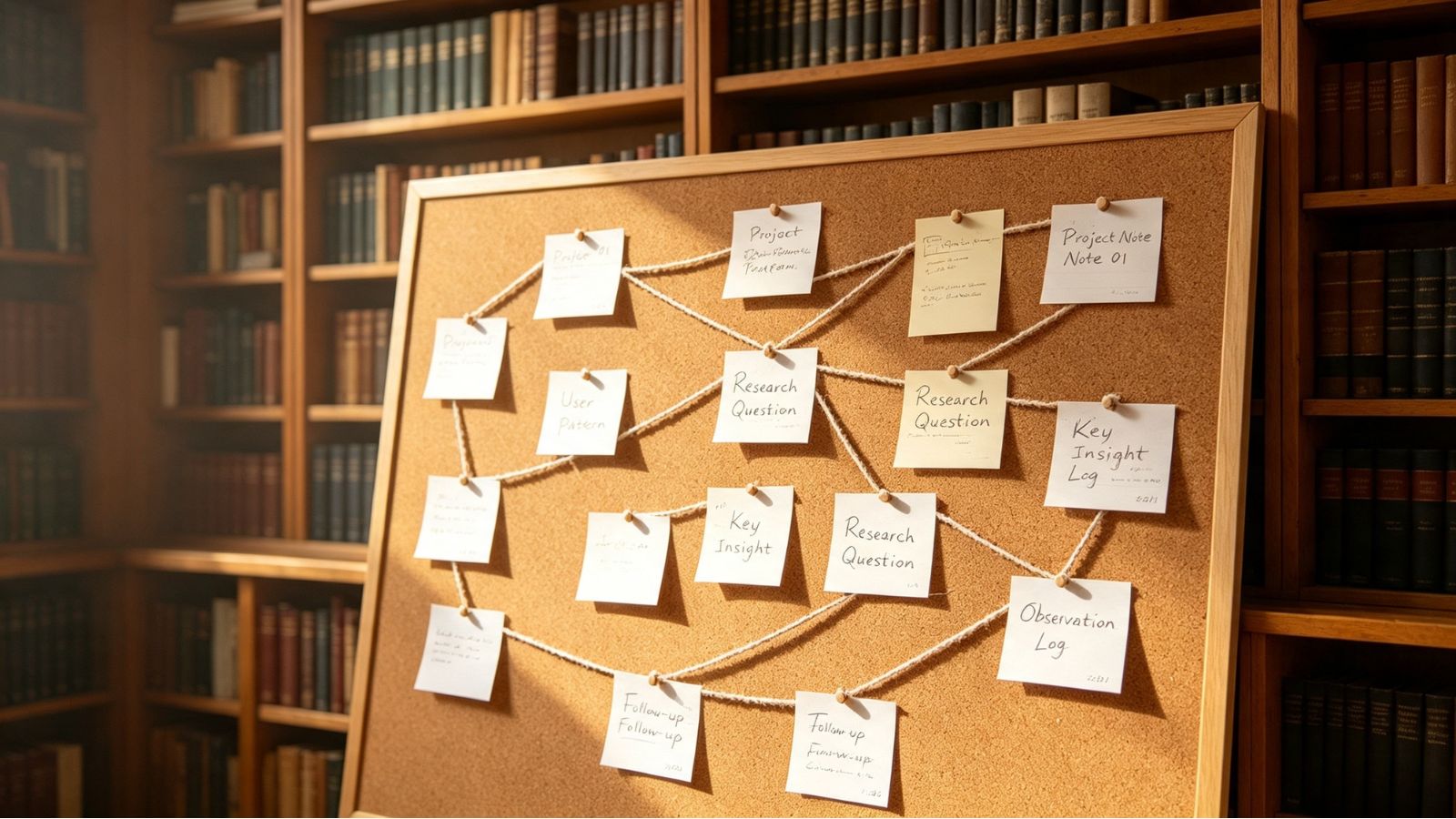
Many abandoned second-brain systems fail for the same reason: they require too much effort.
A sustainable workflow usually follows three simple steps:
Capture quickly.
Save useful information without interrupting your work.
Organize when necessary.
Add structure when information becomes important to an active project.
Review occasionally.
Delete outdated materials, combine duplicate notes, and keep only information that still provides value.
A second brain should reduce cognitive friction rather than create another ongoing task.
A second-brain approach is neither a productivity shortcut nor a universal solution.
People working on complex, long-term, or information-heavy projects often benefit from an external knowledge system because it preserves context and improves retrieval.
For simpler workflows, however, standard folders and basic note-taking tools may be completely sufficient.
The most effective second brain is not the one with the largest database or the most sophisticated structure.
It is the one that supports your work without becoming another project that needs to be managed.