
A project can have all the right tools and still become difficult to manage. Many teams use a communication platform for daily discussions, a project management system for tracking work, and shared documents for planning and knowledge storage. On paper, this combination appears organized. In reality, important information often becomes scattered across different places. A deadline changes in a conversation, a decision is mentioned during a meeting, and a critical update remains buried inside a document that few people remember to revisit.
The challenge is usually not a lack of information. Most teams have more information than they can effectively manage. The real difficulty is determining which information matters, where it should be stored, and who is responsible for maintaining it. When these decisions are unclear, employees spend more time searching for context, repeating discussions, and resolving disagreements about what is current.
Standardizing project information across communication, documentation, and management platforms creates a more reliable operating structure for teams. It does not require replacing every existing tool or forcing employees into rigid processes. Instead, it establishes practical expectations about how information moves through a project, from early conversations to final decisions and completed work.
For small and medium-sized organizations, this becomes especially important because the same people often handle multiple responsibilities. A product manager may coordinate with engineering, marketing, sales, and customer teams at the same time. Without consistent information practices, projects can become dependent on individual memory instead of shared understanding.
Many organizations assume information problems are caused by having too many platforms. While excessive tool usage can create unnecessary complexity, the deeper issue is usually that teams have not defined the role of each system. Different platforms are adopted for different reasons, but employees are rarely given clear guidance about what information belongs where.
Consider a 30-person software company preparing a major product launch. The engineering team manages development tasks in a project management system. Marketing maintains campaign schedules in shared documents. Customer success managers discuss client expectations through communication channels. Leadership reviews progress during weekly meetings. Every department has valuable information, but no consistent connection exists between these sources.
As the launch date approaches, small inconsistencies begin affecting decisions. Marketing may prepare announcements based on an outdated feature timeline. Customer teams may communicate commitments that no longer match development plans. Managers may spend meetings collecting basic updates instead of discussing risks and solutions. The company does not have an information shortage; it has a coordination problem.
This situation appears in many industries, including software companies, consulting firms, creative agencies, manufacturing teams, and nonprofit organizations. The tools may change, but the underlying challenge remains similar: important knowledge exists across multiple locations without a clear system for maintaining alignment.
The solution is not eliminating every platform. Different tools serve different purposes. The important step is creating clear relationships between them so employees understand where discussions happen, where decisions are recorded, and where active work is managed.
Introducing another software tool rarely fixes unclear information practices. A new knowledge base or project dashboard may provide more storage space, but it does not automatically solve the question of who maintains the information or which version should be trusted.
Every project contains different types of information, and each type requires a clear owner. Some information supports short-term collaboration. Some preserves decisions for future reference. Some coordinates daily execution. Problems occur when these categories become mixed together.
For example, a project deadline should have one recognized source. If the same date appears in a spreadsheet, a meeting summary, and a project management system, employees may waste time confirming which version is accurate. Similarly, a major product decision should not remain only inside a conversation thread because future team members may need the reasoning behind that choice.
Effective teams create simple ownership rules. They decide where project timelines are maintained, where requirements are documented, where risks are tracked, and where decisions are recorded. These agreements reduce uncertainty because employees no longer need to search through multiple systems without knowing which one contains the answer.
Good information management also requires recognizing what does not need to be documented. Not every conversation deserves a permanent record. A quick question between colleagues does not need formal storage. The information worth preserving is usually information that affects future decisions, such as changes to scope, customer commitments, deadlines, responsibilities, or strategic direction.

A practical information system begins with understanding the different jobs each platform performs. Communication tools, documentation systems, and project management platforms should complement one another rather than compete for the same purpose.
Communication platforms are designed for interaction. They help teams exchange ideas, ask questions, solve problems quickly, and coordinate daily activities. These conversations are often where valuable insights appear. However, conversations are not always reliable long-term records because important information can disappear as new messages replace older discussions.
Documentation platforms provide continuity. They preserve information that people may need after the original conversation has ended. This includes project requirements, decision records, research findings, processes, and lessons learned. Strong documentation focuses on useful context rather than recording every activity.
Project management platforms connect information to execution. They show what needs to happen, who owns the work, what deadlines exist, and which dependencies may affect progress. These systems are most effective when they reflect current commitments instead of becoming storage locations for every project detail.
A simple distinction helps teams maintain clarity:
Communication platforms support discussion.
Documentation platforms preserve knowledge.
Project management platforms organize commitments.
This separation does not reduce collaboration. It improves collaboration by making important information easier to locate when teams need it.
Projects rarely begin with complete information. They start with conversations, questions, customer feedback, and competing ideas. Early discussions need flexibility because teams are exploring possibilities and evaluating options.
The challenge begins when those conversations create decisions that affect future work. A product team may decide to delay a feature, change a requirement, or adjust a launch strategy. If the decision remains only in a meeting or chat discussion, the organization may lose important context later.
A stronger approach is creating a natural flow:
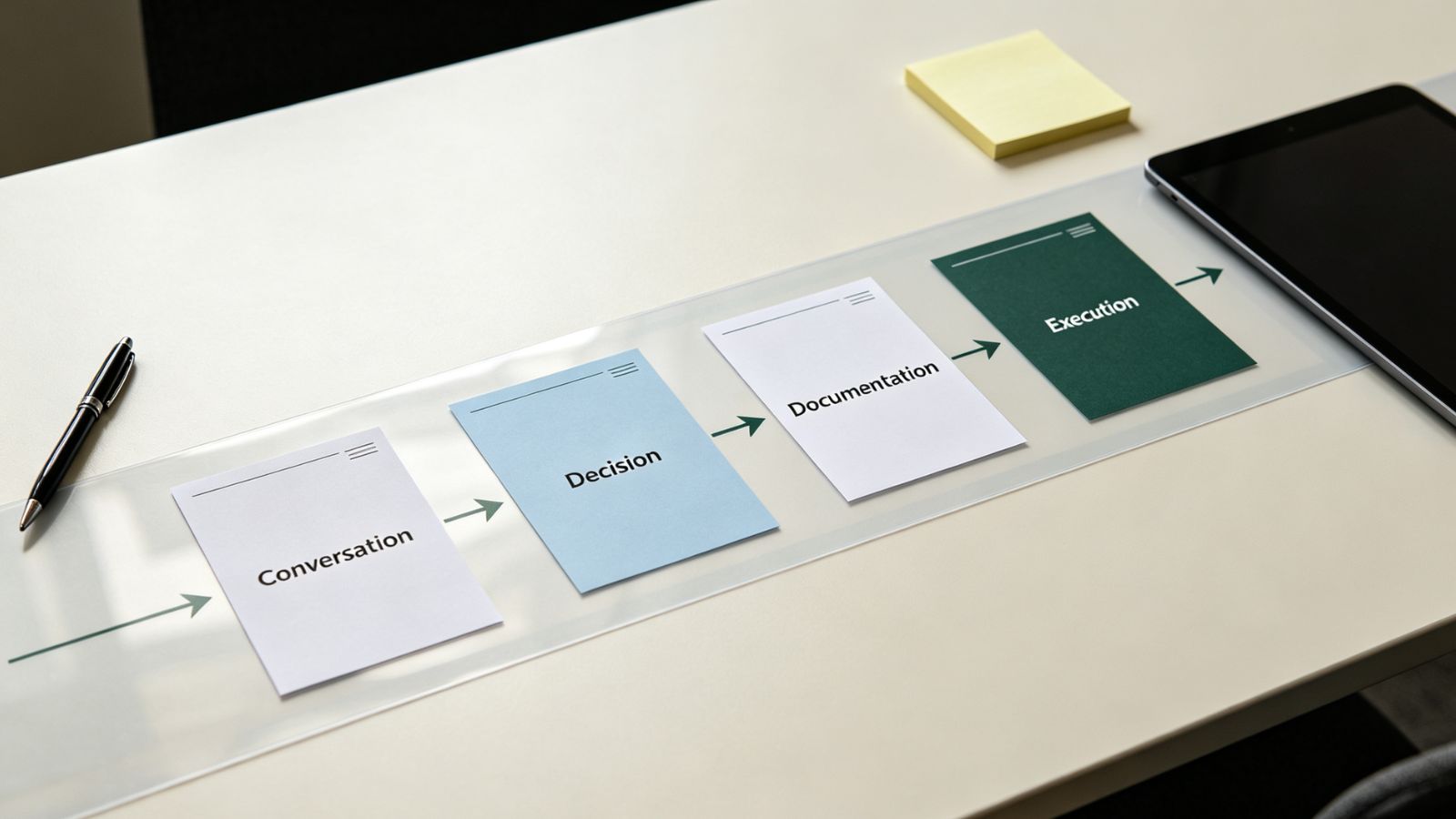
Conversation → Decision → Documentation → Execution
The conversation stage allows teams to explore ideas. The decision stage identifies what has been agreed upon. Documentation preserves the reasoning and important details. Execution systems translate the decision into assigned work and measurable progress.
For example, if a customer request changes product priorities, the discussion may happen in a communication channel. Once the team decides to adjust the roadmap, that decision should be recorded with the reason behind it. The project management system should then reflect the updated tasks, ownership, or timeline.
The value of this approach is not creating additional paperwork. It is preventing information from being disconnected. A decision without documentation may need to be explained repeatedly. Documentation without execution may become outdated. Execution without context may lead teams toward the wrong outcome.
A growing software company preparing a new product release noticed that its biggest delays were not caused by technical challenges. The problem was coordination. Product managers discussed priorities during meetings, engineers tracked work separately, marketing prepared announcements using different timelines, and customer teams relied on informal updates to understand release readiness.
The company did not solve the issue by adding another platform. Instead, it created clearer information practices. Product decisions were recorded in a shared documentation space. Engineering tasks remained inside the project management system. Communication channels continued to support daily discussions, but major decisions were moved into permanent records.
The result was not fewer conversations. Teams still collaborated frequently and solved problems together. The difference was that important information had a defined path. Employees knew where to find decisions, where to check project status, and where to confirm current responsibilities.
The same approach can apply beyond software development. A marketing agency managing client campaigns, a consulting firm coordinating multiple engagements, or a nonprofit organizing a large initiative can face similar information challenges. The specific tools may differ, but the need for reliable information flow remains the same.
One concern about standardization is that it may create unnecessary bureaucracy. Teams worry that every conversation will require documentation and every meeting will produce additional administrative tasks. Poorly designed processes can create this problem, but effective standards should reduce effort rather than increase it.
A practical approach is starting with areas that create the most confusion. Teams do not need to redesign every workflow immediately. They can begin with high-impact information, such as project updates, major decisions, customer commitments, product requirements, or release planning.
Simple templates often provide enough structure. A decision record might include only the decision, the reason, the participants, and the next actions. A weekly project update may only require current progress, major risks, and upcoming priorities.
The success of standardization can be measured through everyday signals. Teams may notice fewer repeated questions, meetings that spend more time on decisions rather than status collection, and fewer disagreements caused by outdated information. These improvements indicate that information is becoming easier to trust and use.
The right level of structure depends on the organization. A five-person startup and a large enterprise will not need the same processes. Effective standards are flexible enough to match the team’s size, workflow, and complexity.
One common mistake is allowing important updates to bypass established systems because they appear urgent. A customer request, executive decision, or unexpected issue may feel too time-sensitive to document. However, these exceptions often create future confusion when other teams need to understand what changed.
Another mistake is maintaining multiple sources of truth. When teams manage separate versions of schedules, requirements, or priorities, collaboration becomes dependent on constant checking and correction. A reliable system requires clarity about which source should be considered authoritative.
Organizations also sometimes focus too much on collecting information and not enough on maintaining useful information. A large archive of outdated documents does not improve decision-making. Valuable information needs ownership, relevance, and occasional review.
Finally, teams should avoid copying another company’s process without considering their own environment. The best information system is not the most complicated one. It is the one that helps employees quickly find accurate information and use it to make better decisions.
Standardizing project information across communication, documentation, and management platforms is ultimately about creating confidence. Teams work more effectively when employees know where information exists, which version can be trusted, and who is responsible for maintaining it.
The purpose is not to replace human collaboration with systems. Conversations, creativity, and informal problem-solving remain essential parts of successful projects. The difference is ensuring that valuable knowledge does not disappear when conversations end.
When teams establish clear platform roles, define information ownership, and create a reliable path from discussion to execution, project work becomes easier to coordinate. The biggest improvement is often simple: employees spend less time searching for information and more time using that information to make better decisions.